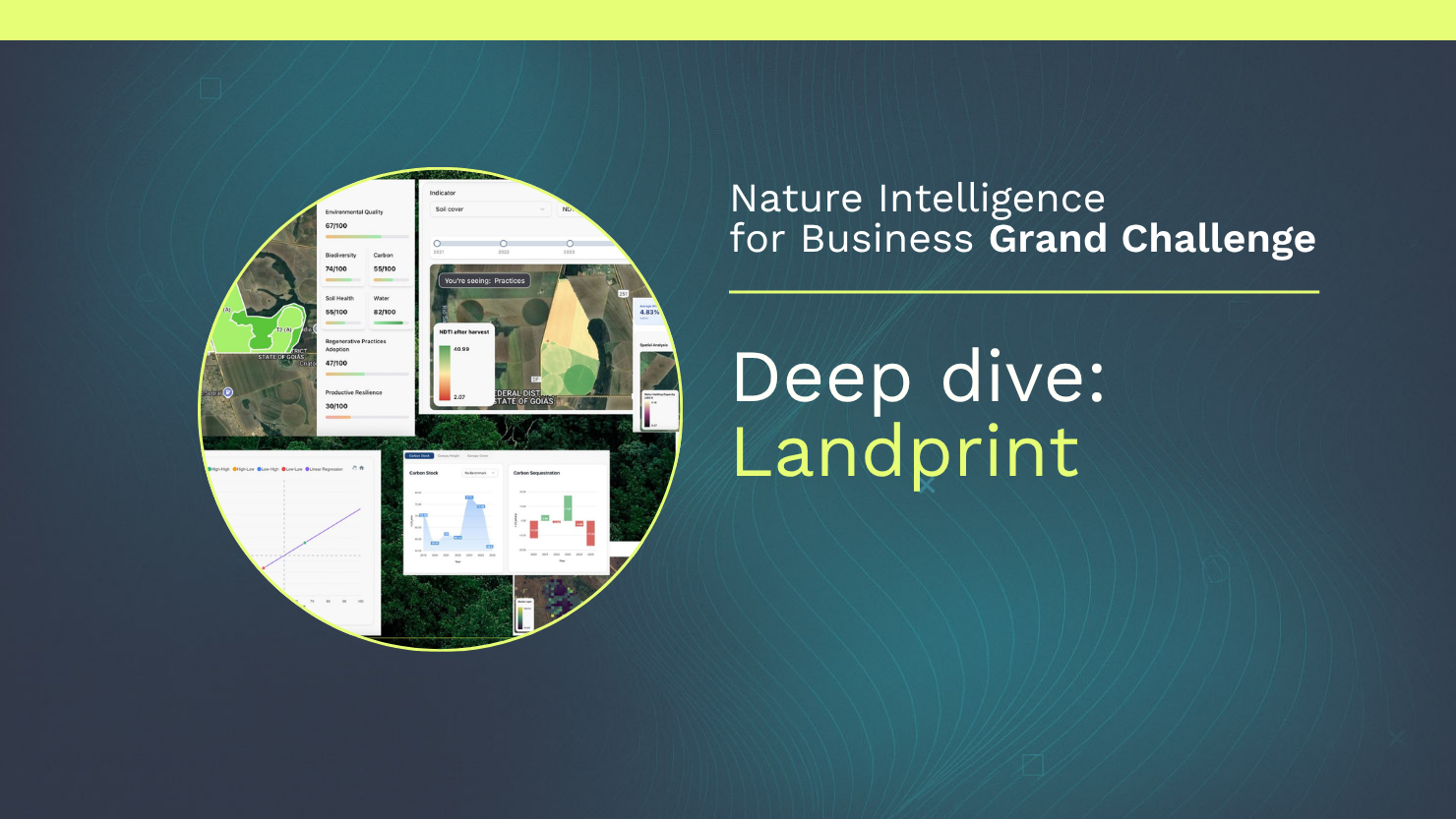
For Landprint, transforming global supply chains requires building from the ground up. Born out of a 15-year, multi-million dollar climate resilience initiative in the semi-arid region of Brazil, the data platform serves as a specialized infrastructure layer that unifies agricultural communities, multinational corporations, and global financial institutions. By converting chaotic fieldwork metrics into clear, standardized physical and financial risk models, Handprint enables commercial enterprises to justify, scale, and confidently mobilize capital into localized nature-based solutions.
Most data platforms approach supply chain tracking from a top-down, corporate perspective—prioritizing high-level dashboard metrics that satisfy distant regulatory boards but offer little utility to operators on the ground. This separation creates deep friction within nature markets. Small family farms and grassroots cooperatives are frequently inundated with fragmented, overlapping requests for ecological data from various buyers and lenders, yet they rarely see any financial benefit or strategic guidance in return. When data collection feels like an asymmetric administrative tax, data quality drops and local participation stalls.
To unlock scalable landscape restoration, environmental tech must move away from purely extractionary monitoring models and embrace a farmer-centric framework. The primary obstacle to scaling regenerative agriculture isn't a lack of willingness among producers; it is a profound lack of confidence and financial security during the multi-year transition period. Flipping the script means utilizing data not just as a compliance shield for corporations, but as a financial asset for the farm—proving how verified soil regeneration, habitat uplifts, and reduced physical risks systematically lower the cost of capital and secure higher commercial valuations.
This structural integration is exactly what Landprint is built to coordinate. Leveraging its foundations in applied statistical modeling and decades of rural development experience, the platform establishes a homogeneous, end-to-end data layer that connects every tier of the agricultural value chain. Instead of treating environmental metrics, corporate risk assessments, and impact investment requirements as separate data streams, Landprint unifies them into a structured, three-phase operational cycle designed to convert raw data into targeted landscape investments.
This structural methodology translates into a clear, reliable pathway for corporate boards and global lenders:
The real-world versatility of this architecture allows LandPrint to serve highly diverse operations simultaneously. The platform handles complex portfolios for publicly listed corporations while remaining fully accessible to small-scale agricultural cooperatives across Latin America and Africa. By standardizing indicators across disparate geographic biomes, the system allows global enterprises to aggregate total performance metrics seamlessly. This robust tracking transforms nature-positive goals from speculative marketing initiatives into repeatable, bankable projects capable of scaling reliably to meet global investment demands.
Landprint was selected as a finalist in the Nature Intelligence for Business Grand Challenge—a global competition convened by Conservation X Labs, the Taskforce on Nature-related Financial Disclosures (TNFD), and the United Nations Development Programme (UNDP) to find affordable, accessible nature data tools for small and medium-sized enterprises (SMEs).
For a platform rooted in grassroots agricultural programs, scaling internationally requires proving that community-first data methodologies can seamlessly align with the rigorous financial standards of institutional markets. The Grand Challenge offered LandPrint an ideal global proving ground to demonstrate that deeply rooted field tracking and advanced statistical risk modeling are completely complementary.
During the finalist evaluation phase, the team demonstrated their unified framework across active global supply chains, showing how clear metrics can de-risk the transition to regenerative farming for smallholders while simultaneously providing institutional investors with verified, auditable data. By positioning their platform as the essential middle layer between grassroots organizations and institutional capital, LandPrint has outlined a practical path to mobilize billions in environmental financing. The work of these innovators is just getting started, proving that the future of nature-positive business is already here.