For Innovanalisis, true sustainability requires aligning a company's bottom line with the health of its surrounding ecosystem. Developed by the specialist consulting firm Inanálisis, the platform establishes a direct, data-driven bridge between financial forecasting and ecological impact.
For decades, the fields of conservation science and commercial finance have operated in parallel silos, speaking entirely different structural languages. Traditional corporate financial models are built to track capital allocation, revenue projections, and regulatory compliance, but they rarely incorporate the dynamic variables of natural ecosystems. Conversely, biodiversity frameworks focus on habitat health and species distribution, frequently leaving out the practical, operational economics that determine whether a business can afford to adopt restorative practices. This disconnect forces agricultural enterprises to treat environmental stewardship as an expensive administrative burden rather than a core driver of asset value.
This operational divide becomes highly critical as global market pressures intensify. As stricter international regulations like the European Union Deforestation Regulation (EUDR) go into effect, companies frequently treat nature management as a rigid, box-checking exercise designed solely to mitigate legal risk. However, viewing ecological health purely through the lens of compliance causes organizations to overlook substantial commercial opportunities. True long-term resilience is unlocked only when an enterprise can model its relationship with the land as an active economic partnership, demonstrating how strategic interventions can simultaneously lower operational risk, enhance crop yields, and open access to specialized green capital markets.
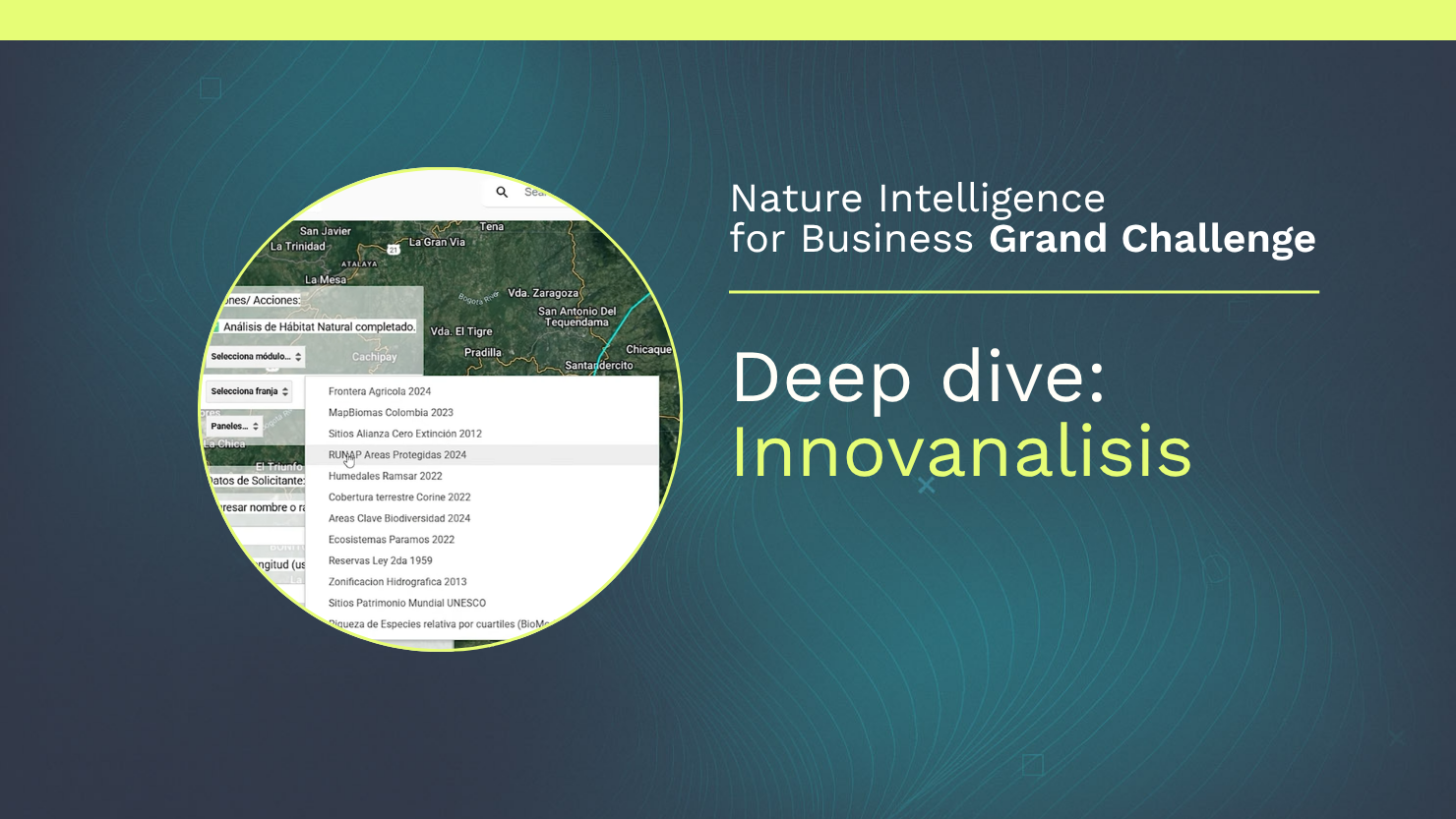
This critical gap is exactly what Innovanalisis designed to close. Drawing on extensive experience in sustainable finance, innovation management, and biodiversity conservation, the development team built a platform that unifies geographic information systems (GIS), classical economic indicators, and ecological impact metrics into a single data architecture. Instead of evaluating environmental trends and corporate profit margins on separate spreadsheets, the platform draws on global empirical studies and localized field data to simulate the precise, real-time interplay between land-management choices and business profitability.
The true power of this methodology lies in its ability to quantify the temporal trade-offs associated with transitioning to regenerative agriculture. For example, when a coffee producer in Peru or Colombia considers implementing nature-based solutions like agroforestry networks or dedicated pollinator strips, traditional accounting models only capture the upfront operational costs and an immediate, temporary dip in crop density. Innovanalisis alters this equation by projecting the long-term economic trajectory—demonstrating how enhanced soil biology and increased pollinator activity systematically elevate crop quality, stabilize yields over time, and protect the farm against climate-induced shocks.
Beyond individual farm management, this integrated modeling provides massive structural utility to the international banking sector. Major financial institutions deploying specialized capital instruments—such as corporate biodiversity bonds—require clear, transparent methodologies to ensure their credit lines do not inadvertently damage critical habitats. Innovanalisis addresses this need by aligning localized asset data directly with strict international benchmarks like the International Finance Corporation’s Performance Standard 6 (IFC PS6). This alignment allows commercial lenders to easily monitor regional risk profiles, verify positive environmental performance, and confidently structure sustainable lending portfolios that support landscape restoration.
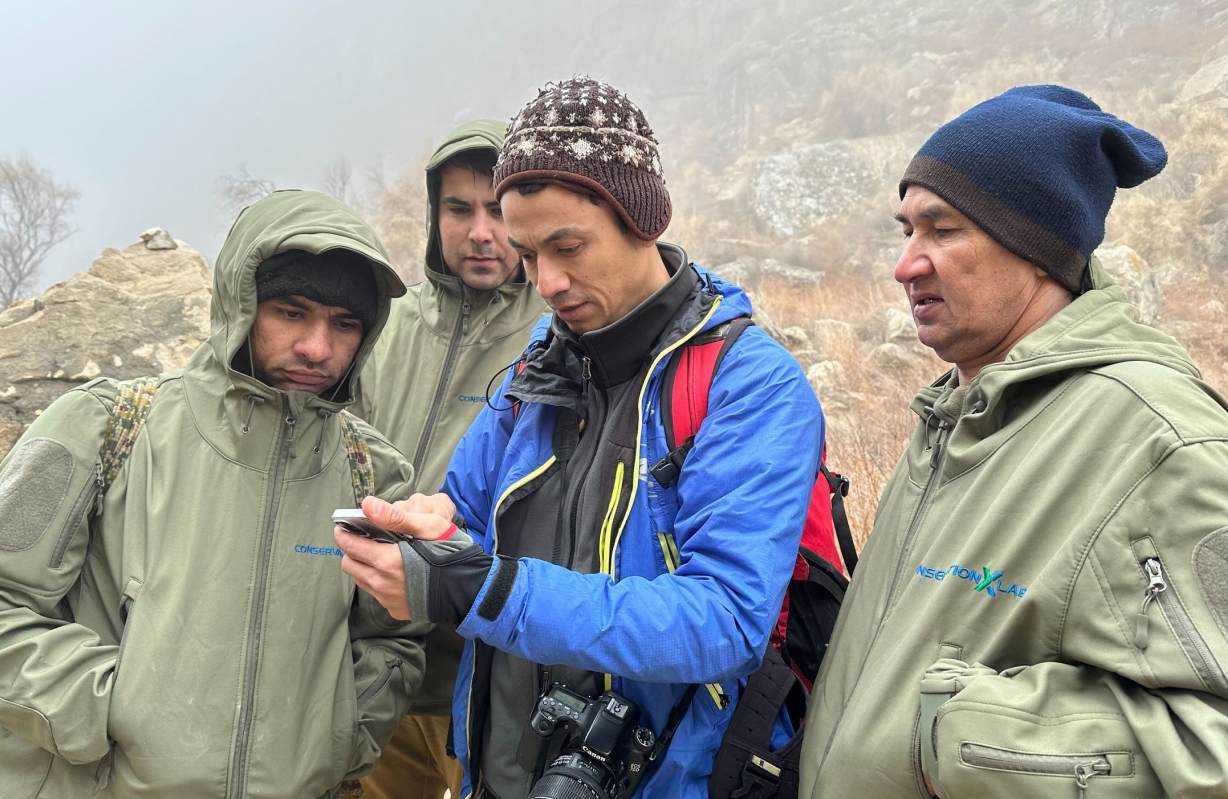
Innovanalisis was selected as a finalist in the Nature Intelligence for Business Grand Challenge—a global competition convened by Conservation X Labs, the Taskforce on Nature-related Financial Disclosures (TNFD), and the United Nations Development Programme (UNDP) to find affordable, accessible nature data tools for small and medium-sized enterprises (SMEs).
For an early-stage innovation platform, the primary operational challenge is translating complex, academic environmental correlations into a standard format that corporate financial officers and credit risk analysts can seamlessly trust. For the creators of Innovanalisis, the Grand Challenge provided an invaluable global sandbox to stress-test their underlying data sets against the practical, everyday constraints faced by agricultural producers and financial institutions in highly competitive markets.
During the finalist evaluation phase, the team refined their modeling alongside active supply chain participants in Latin America, demonstrating that integrating nature data into standard cash-flow projections is both technically achievable and financially clarifying. By proving that ecological health can be modeled as a core asset rather than an ongoing regulatory expense, Innovanalisis has established a blueprint for the future of land management. The work of these innovators is just getting started, proving that the future of nature-positive business is already here.