

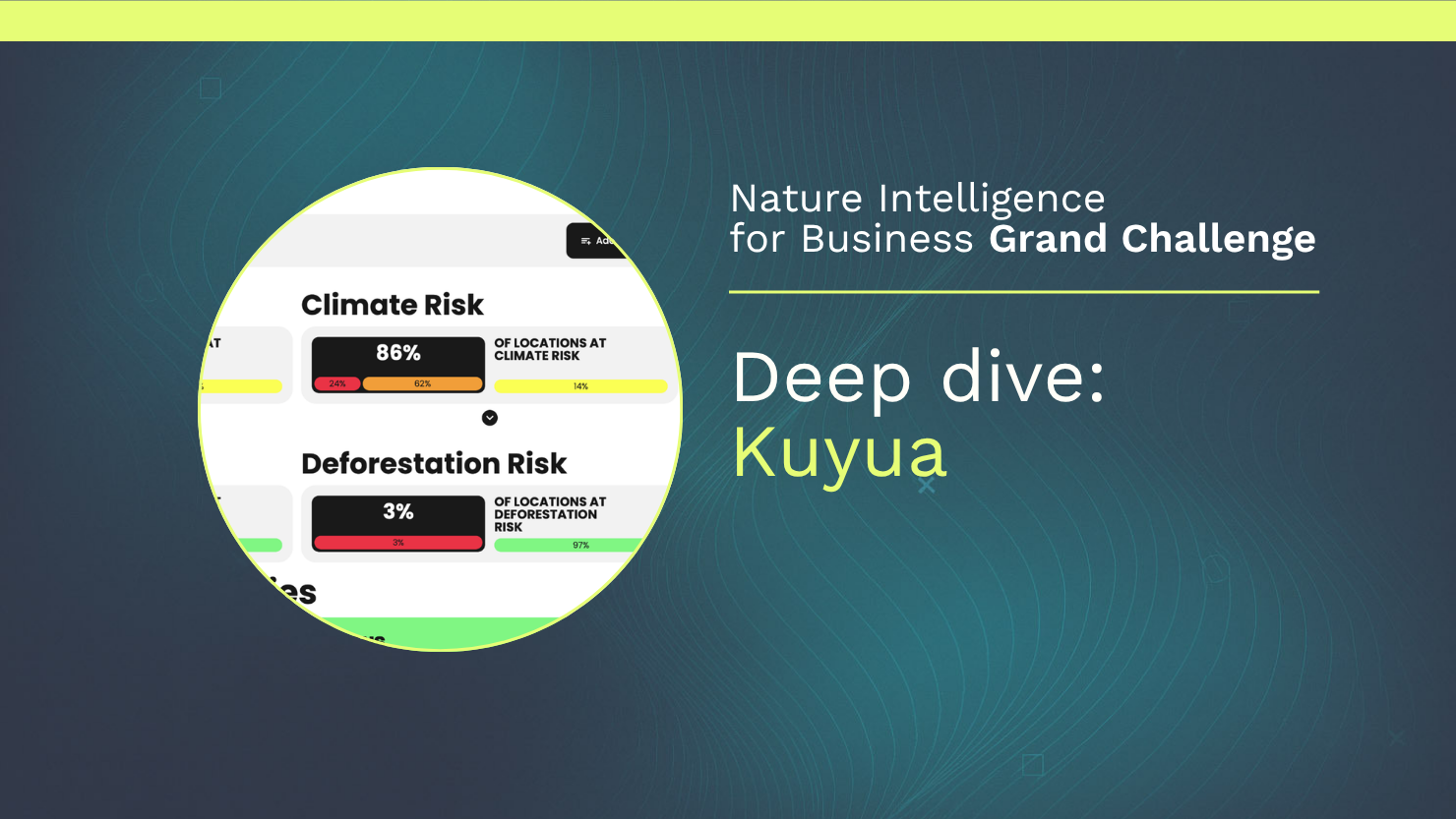
For Kuyua, climate change and nature degradation are two sides of the same coin—interconnected forces that cannot be managed in isolation. Developed by a team of finance professionals, ecologists, and machine learning experts, the Kuyua SaaS platform simplifies how organizations evaluate environmental dependencies. By requiring only two foundational data points—an asset's geographic location and its specific operational activity—the system automatically maps complex local vulnerabilities, providing commercial enterprises with a direct translation of ecological risk into clear financial values.
-
Within corporate governance structures, biodiversity and nature management have historically been relegated to qualitative ESG reporting or siloed as altruistic corporate social responsibility projects. While climate metrics and carbon accounting have successfully made the leap into boardroom strategies, nature risks frequently remain hidden behind dense, academic terminology that fails to resonate at the CFO level. This language gap creates a dangerous blind spot; budgets for biodiversity continue to drop even as physical risks—such as water scarcity, soil erosion, and severe weather—threaten the continuity of global supply chains.
To break through this operational inertia, corporate nature tools must shift from vague, descriptive assessments to clear, quantitative analytics. When an ecosystem vulnerability is expressed purely in terms of habitat loss, it struggles to compete for corporate capital against immediate financial demands. However, when that exact same ecological threat is modeled as monetary value at risk, it is immediately transformed into a material business priority. Bridging this communication gap allows companies to see that investing in targeted, nature-based mitigation solutions is not a regulatory expense, but a fundamental strategy for protecting capital.
Fusing Big Data and AI to Demystify Landscape Risks
This is the exact operational translation that Kuyua’s software architecture is built to execute. Combining natural capital accounting principles with predictive financial modeling, the platform strips away the high barrier to entry that typically stalls corporate sustainability assessments. Instead of forcing an enterprise to conduct expensive, multi-month site audits, the system uses its core location engine to cross-reference an asset's footprint with more than 100 distinct open-source and proprietary environmental data points, tracking overlapping risks across climate, water stress, and regional deforestation.
Managing this massive influx of geospatial information presents a significant user-experience challenge, particularly for lean organizations without dedicated sustainability teams. To prevent analytical fatigue, Kuyua pairs an intuitive risk-cascade UI with a specialized, multilingual AI engine. This agent acts as a translation layer, synthesizing vast amounts of raw data into localized, actionable summaries. For a manufacturer evaluating a factory or an agricultural business assessing a landscape, the platform bypasses complex scientific jargon to reveal precisely how climate patterns and ecological degradation reinforce each other on the ground, delivering a ready-made roadmap for targeted mitigation.
The practical value of this approach extends across diverse operational scales and global markets. For large blue-chip corporations, the software provides a scalable framework to conduct portfolio-wide due diligence, allowing them to map their entire operating footprint and systematically roll those assessments down into their broader supply chains. Simultaneously, for small and medium-sized enterprises (SMEs) and localized habitat banks, the ability to generate rapid, auditable financial valuations of ecological risk acts as a major commercial accelerator—providing a trusted, standardized language to secure investments, engage local governments, and demonstrate long-term landscape resilience to global buyers.
The Grand Challenge Experience
Kuyua was selected as a finalist in the Nature Intelligence for Business Grand Challenge—a global competition convened by Conservation X Labs, the Taskforce on Nature-related Financial Disclosures (TNFD), and the United Nations Development Programme (UNDP) to find affordable, accessible nature data tools for small and medium-sized enterprises (SMEs).
For a fast-growing technology platform, entering the SME market requires validating that sophisticated enterprise-grade analytics can operate effectively within lean, resource-constrained business environments. For the creators of Kuyua, the Grand Challenge served as a vital global launchpad to test their software across drastically different regulatory landscapes, corporate structures, and geographic biomes.
During the finalist evaluation phase, the team deployed their platform in real-world pilots spanning from specialized agricultural businesses in Japan to extensive industrial operations in South America. The testing phase proved that by lowering data-entry friction and translating complex ecological metrics into clear financial vulnerability assessments, advanced nature intelligence can be adopted autonomously by any business, anywhere in the world. The work of these innovators is just getting started, proving that the future of nature-positive business is already here.
